
WESTERN WORDSLINGERS—WILL HENRY
WILL HENRY & CLAY FISHER—ONE WRITER, TWO WESTERN LEGENDS

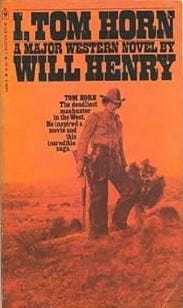
My first exposure to Will Henry’s work was his short story collection I, Tom Horn. Impressed by its authenticity and emotional weight, I sought out his novels and additional short fiction. After reading more than half a dozen of his Westerns, along with another anthology, my admiration only deepened. Henry remains one of the most compelling and underappreciated writers in the genre.
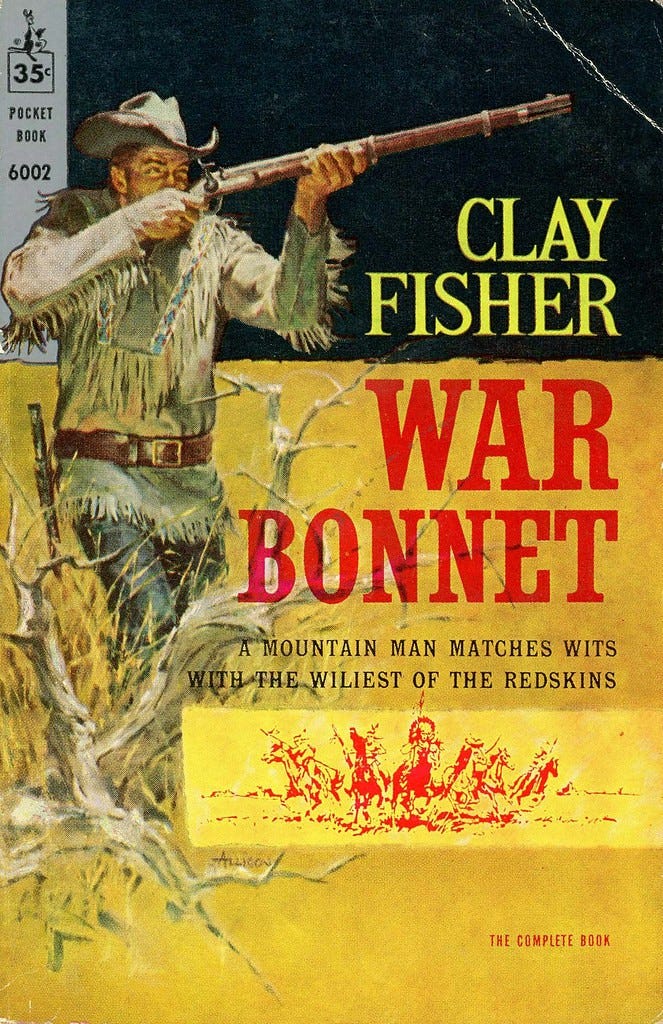
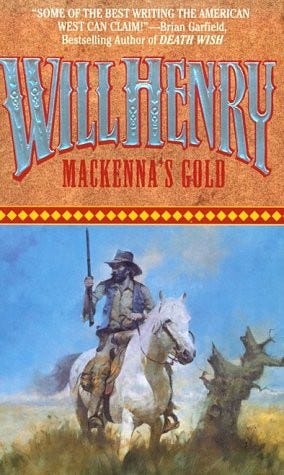
Will Henry and Clay Fisher were pseudonyms used by Henry Wilson Heck Allen, who wrote more than fifty Westerns between 1952 and 1978. In general, Clay Fisher identified his shorter, more action-driven novels, while Will Henry marked books of greater historical and psychological depth. Though this distinction often depended on publishing circumstance rather than artistic intent, it remains a useful lens through which to view his work.
Born in Kansas City, Missouri, in 1912, Allen wanted to be a writer from an early age. At twelve, he submitted stories to Liberty and Collier’s, demonstrating both ambition and confidence. He briefly attended the University of Missouri as a journalism major at his father’s urging, but wanderlust soon took over. Leaving school after less than a year, he traveled west as a self-described vagrant, supporting himself through an array of jobs—shop clerk on an Indian reservation, gold miner, stable hand, sugar mill operator, and countless others. These experiences would later infuse his fiction with lived-in realism.
Eventually, still scraping by, Allen settled in Southern California. He worked as a moving van loader, a service station pump jockey, a veterinary hospital assistant, and even pickforked manure while hot-walking polo ponies. Along the way, he secured a column with the Sunset Reporter in Santa Monica and wrote articles for Dog World and Shepherd Dog Review, drawing on his unlikely credentials as a licensed dog show judge.
In 1935, Allen found work as a freelance gag writer for Hugh Harman and Rudolph Ising’s Barney Bear cartoons. Two years later, at twenty-five, he joined his brother Robert at MGM as a junior story writer, eventually moving into the studio’s cartoon unit. There, he formed a close creative partnership with Tex Avery. Avery, famed for his anarchic humor, called Allen the best gag man I ever worked with and encouraged him to push his comedic instincts to the limit. Together they created or refined iconic characters such as Droopy, Screwy Squirrel, George and Junior, and Red—the Wolf. Their collaborations include classics like Northwest Hounded Police, King-Size Canary, The Shooting of Dan McGoo, and Bad Luck Blackie. Despite his key role, Allen later downplayed his contributions, insisting he merely served as a sounding board for Avery’s ideas.
After a decade in animation, Allen wanted a complete break. A lifelong student of Western and Native American history, he turned to writing Westerns—despite having read little in the genre. To avoid studio conflict, he published his first novel, No Survivors (1952), under the name Will Henry.
No Survivors is a striking debut—a first-person reconstruction of Custer’s last campaign, told largely from a Native American perspective. Narrated by John Clayton, a fictional ex-Confederate officer adopted into the Oglala Sioux, the novel combines meticulous historical detail with deep emotional power. Clayton lives for years as an Indian, rides with the renegades, and ultimately faces a wrenching reckoning at Little Bighorn. The book remains one of the strongest first novels I’ve ever read.
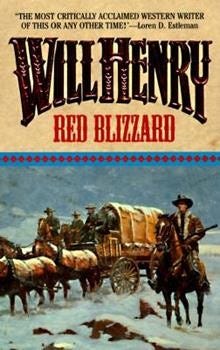
Its success allowed Allen to leave MGM and write full-time from his home in Encino. When Random House rejected his second novel, Red Blizzard—a bleak, ahead-of-its-time examination of racism—Allen published it under the Clay Fisher name. From then on, he wrote under both pseudonyms. If Random House accepted a manuscript, it appeared as Will Henry—if not, it became a Clay Fisher book elsewhere.
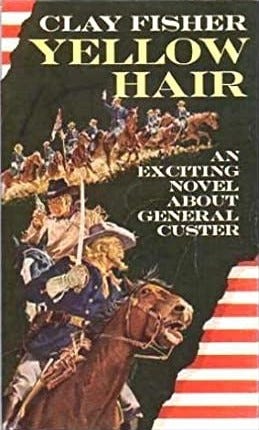
This divide is well illustrated by Yellow Hair (1954), written as Clay Fisher, and Custer’s Last Stand (1976), published as Will Henry. Yellow Hair, centered on the Washita massacre, emphasizes character and action, while Custer’s Last Stand foregrounds exhaustive historical research. For the latter, Allen consulted hundreds of firsthand accounts from soldiers and Native Americans alike. The result is a balanced yet unsparing portrait of arrogance, courage, hatred, and sacrifice, with Custer portrayed as a brilliant but narcissistic figure undone by his own flaws and fractured command.
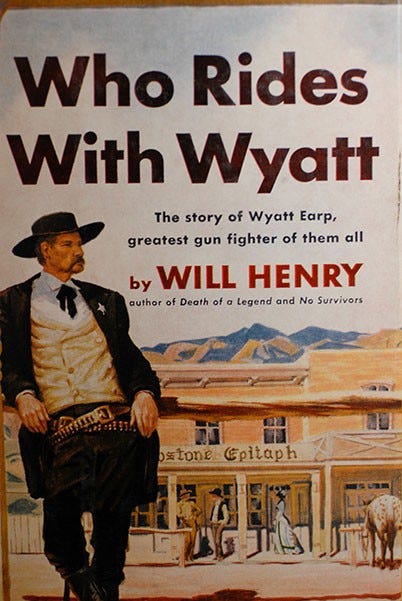
Other standout works include Who Rides With Wyatt, a fast-moving, speculative take on Wyatt Earp rooted in oral history, and From Where the Sun Stands Now (1959), Allen’s Spur Award–winning novel about Chief Joseph’s 1877 retreat. Told through the eyes of a seventeen-year-old Nez Perce warrior, it is one of the most haunting depictions of historical tragedy in Western fiction.
Allen’s novels share certain traits: fictional protagonists embedded in historical events, heroines often idealized rather than fully realized, and a willingness to bend fact in service of character. Yet his writing is vivid, gritty, and humane. Violence has consequence. Heroes are survivors, not saints. His sympathy for Native American characters was genuine and sustained. Eight of his novels were adapted for film, and he won five Spur Awards along with the Levi Strauss Award for lifetime achievement. Bantam Books alone sold more than fifteen million paperbacks of his work.
Allen once described himself as a loner, a shadow rider, born into the wrong century. This sensibility permeates his fiction. When I close a Will Henry or Clay Fisher novel, I’m left not merely entertained, but altered—my perspective shifted. Judging by the millions of readers who feel the same, I’m hardly alone.
I always liked the Will Henry books. Too many people don’t realize that there were a lot of good Westerns that took the side of native peoples. Some of those old Double D Westerns were pretty darn good books.
Oh, man. This is the kind of post I love. I knew about the two names, but had no idea they were the same person. Got to read them. Funny how many Western writers bummed around before they started serious writing. I know Ernest Haycox did the same thing. Great post, Paul.