
THE SEARCHERS
ALAN LE MAY


The Searchers has lingered in the American imagination since its 1954 publication, largely because of John Ford’s towering film adaptation. Yet stripped of cinematic reverence, Alan Le May’s novel stands as a stark American masterpiece on its own—lean, unsettling, and far darker than its reputation suggests. Where the film mythologizes, the book interrogates. Its emotional landscape is harsher, its moral boundaries far less certain, and its vision of the frontier closer to nightmare than legend.
The premise appears simple—a years long hunt for Debbie, a young girl kidnapped by Comanches who slaughter her family during a raid in the Texas panhandle. What follows, however, is anything but simple. Beneath the pursuit lies a story steeped in obsession, racial hatred, and moral corrosion, threaded with tensions both dangerous and faintly psychosexual. The novel asks not whether Debbie can be rescued, but whether rescue itself is even possible after prolonged exposure to violence and cultural erasure.
Debbie’s uncle, Amos Edwards, a Civil War veteran and notorious Indian fighter, is consumed by a hatred that has stripped him of mercy. He does not pursue Debbie to save her, but to kill her—convinced she has been irrevocably tainted by her captors. Riding alongside him is Martin Mart Pauley, an adopted member of Debbie’s family whose own parents were killed by Comanches. Where Amos is driven by rage, Mart is propelled by guilt as he ignored Debbie the day before her abduction, a small failure that metastasizes into lifelong responsibility. Their partnership becomes the novel’s moral axis, a tense balance between vengeance and redemption.
The search stretches across years and borders, evolving into an endurance trial of skirmishes, blizzards, ambushes, and relentless survival. Time itself becomes an antagonist. Seasons pass, identities shift, and the men pursuing Debbie risk becoming as lost as the girl they seek. As they close in on Scar, a Wolf Clan chieftain, legend gathers around them. To the Comanches they become figures of myth—Bull Shoulders and The Other—names suggesting violence has erased individuality on both sides. The pursuit ceases to be a rescue mission and becomes instead a ritual of mutual dehumanization. Along the way, Amos develops a grudging respect for Mart, even as his own soul calcifies, intimating proximity to hatred leaves no one unchanged.

Le May’s own journey matches the novel’s unlikely greatness. A pulp writer since the 1920s and later a journeyman Hollywood screenwriter, he stumbled upon the story while working in the Texas panhandle. What began as a conventional tale of frontier violence evolved into his crowning achievement—a piercing examination of what vengeance costs those who refuse to relinquish it. His prose reflects pulp discipline at its best—economical, unsentimental, and deceptively plain, allowing brutality to emerge without rhetorical cushioning. The restraint makes the violence more disturbing, not less.
Le May later inverted these themes in The Unforgiven, in which a child believed to be white is revealed to have been stolen from a Kiowa village—another morally thorny narrative adapted to the screen by John Huston. Together, the two works form an unofficial diptych exploring identity, belonging, and the fragile fiction of cultural purity that haunted the American frontier.
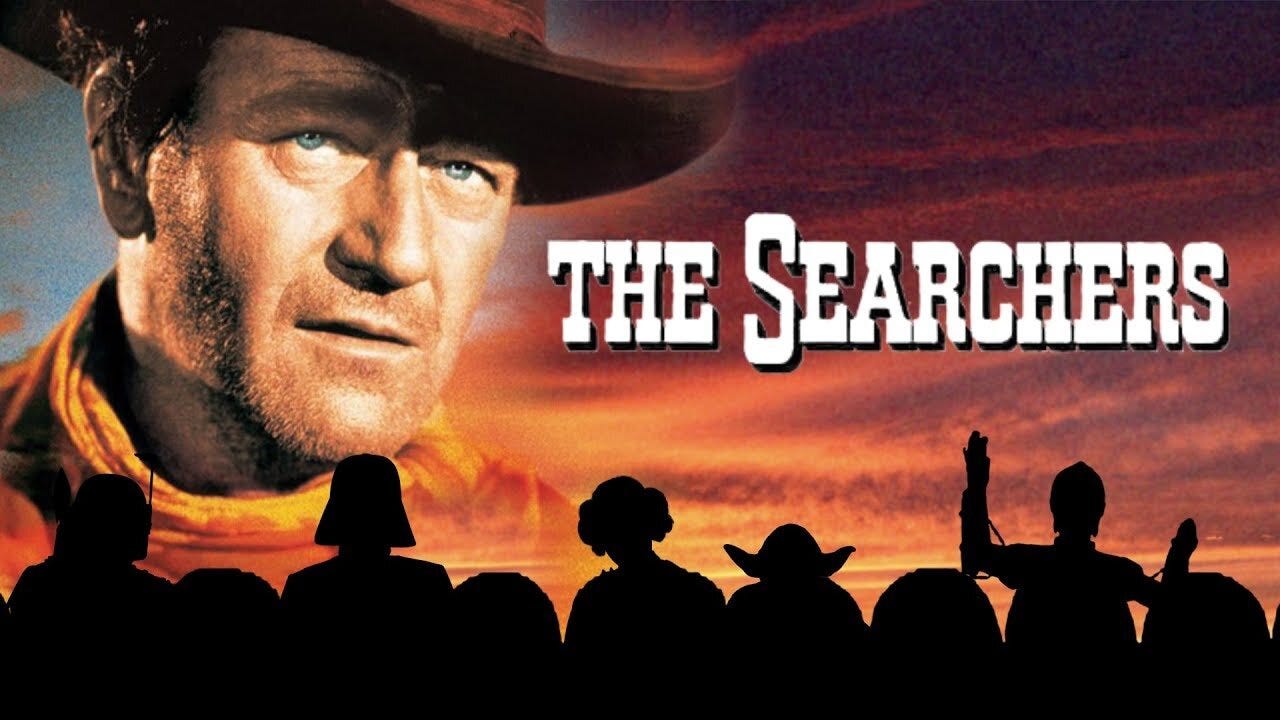
The Searchers, Ford’s 1956 adaptation, remains rightly hailed as one of the greatest Westerns ever made, anchored by a layered, career-defining performance from John Wayne. Yet the novel is the rawer experience—less romantic, more corrosive, and unwilling to look away from the uglier truths at its core. Le May denies readers the comfort of myth. Heroism dissolves into obsession, justice blurs into revenge, and the frontier reveals itself not as a place of renewal but of psychological ruin.
This is not a heroic tale of the West. It is a reckoning—one arguing the true cost of conquest is measured not only in lives lost, but in the souls who survive.
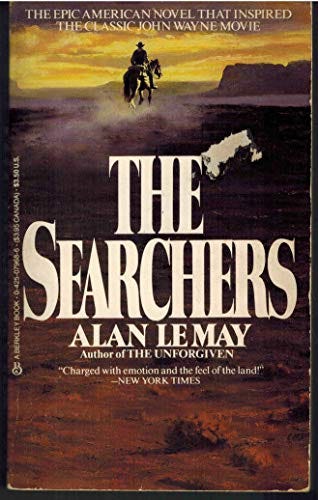
I’m embarrassed that I didn’t realize the movie was based on a book. Thanks for the great review. Off to find it now.
An insightful post about a great book — which features a great cover painting by Ron Lesser.